
Academics
The greatest sign of success for a
teacher... is to be able to say, "The children are now working as if I did not
exist."
Maria Montessori
Part I: General outline
of academic methods
Part II :
Education through computers
Part III:
Sports
Part IV: Art
Our unique methods:
Primrose School is affiliated to the Council for the Indian School Certificate Examinations, New Delhi, and prepares children for the ICSE 10th standard and ISC 12th std. exams.
With only one classroom or section of 30 students for each standard, the teacher/student ratio at Primrose is very high, enabling us to give full attention to each child's needs. Teachers work with small groups of 4-5 children at a time while the others are absorbed in learning games or recreational play. The most effective ratio is ten students per teacher during pre-school up to standard 5 and 15 students per teacher from 6th onwards.
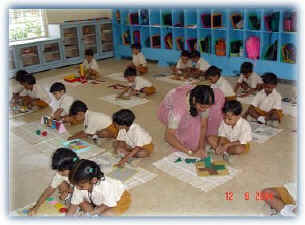
We incorporate many creative additions to the syllabus through our own methods. In the lower levels from pre-KG to UKG, the flash card method of Dr. Glenn Doman is used extensively to teach General Knowledge, English, Tamil and maths. Some of the Montessori methods of teaching are also incorporated in the lower three levels in order to allow the children to become self-starters, self-confident and imaginative self-learners.
~ Computers are introduced in a daily half hour period from the UKG level. CDs with colourful math counting games, drawing games and word games engage the children.
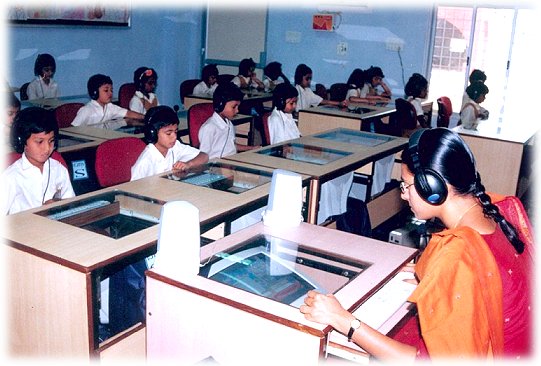
~ Audio visuals
through a projector in the projector room, including video films on nature, science,
language development, etc. and computers using multimedia CDs to teach sciences, geography
and history are also important learning tools.
~ At Primrose, there
is no homework given or
exams until 6th standard.
In the traditional educational method,
homework means copying into a
notebook all the lessons. Instead of formal exams, there is a constant
process of internal evaluation by the teachers and staff and extra help is given to
children in the areas they need it.
~
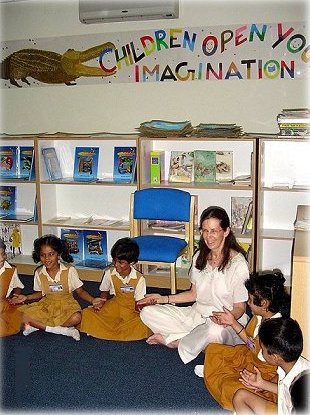
Library period is assigned daily from the 2nd standard onwards where 40
minutes are spent in reading the extensive collection of storybooks, children's
encyclopedias and children's magazines. The Main Library
downstairs caters to children from 2nd to 6th standards, while the Senior
Library in the 2nd floor is for 7th - 12th standards.
The academic
part of the school is based on the following approach:
·
The most important aspect of the
approach is attitude of the teacher, which should be that learning is a form of play which
fosters the blossoming of the child’s natural development. Learning should and can be
made interesting, enjoyable, fun.
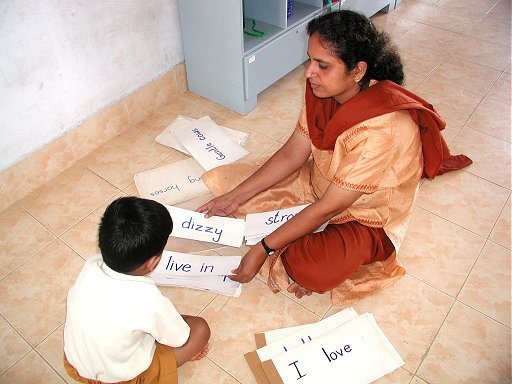
~ The act of teaching in the lower three levels consists primarily of presenting sensory images, objects and information to the child in a pleasant and interesting manner in the form of flash cards. This permits the child to observe and inquire about the subject, without compelling the child to memorize. Coloured flash cards with large images are utilized as convenient, low cost teaching aids.
~ Since the stress is on the idea that
the younger a child is, the better equipped is he to learn, the method is teaching
focused. The child is taught systematically to synchronise two of his sense organs, namely
his eyes and ears. Even as the words are being flashed, the word is called out. The child
learns to assimilate skilfully the two pieces of information being given. The baby is
taught to see a word, hear it and know it simultaneously. The child is taught a word as a
complete unit of sound and its meaning.
~ Rapid acquisition of basic reading and verbal skills in multiple languages occurs naturally by exposing the child to whole words as objects on flash cards repetitively for very brief periods. Story telling is used to make learning fun and to communicate basic values of goodness, beauty, harmony, responsibility and right conduct.
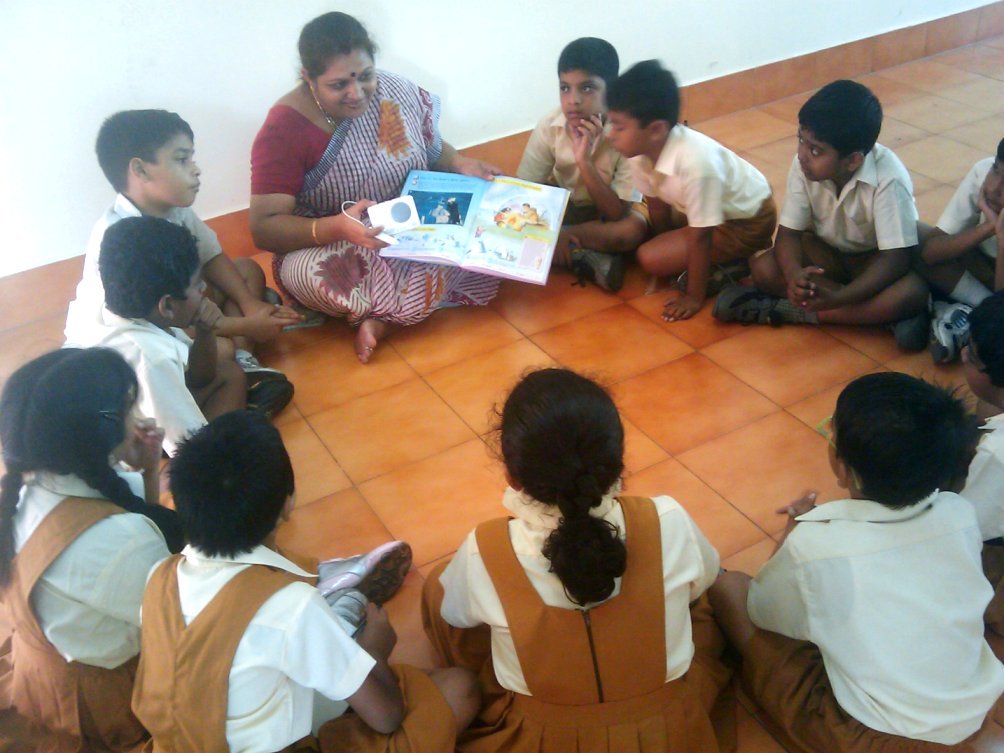
~ The child is not so much taught a
language as much as a skill to acquire and learn as many languages as his environment will
permit. Similarly, the child is taught numerals before numbers and functions in
mathematics. Encyclopaedic knowledge is taught to a child by first teaching bits of information about any topic. The ring of knowledge
is slowly enlarged until it encompasses and includes other topics too. The ring grows big
enough to move from topics to subject to interdisciplinary ideas. The result is a very
broad based learning, a very wide foundation to
understanding, assimilating and finally creating new ideas. Information on people
and other living things, places, history, geography, and other cultures are presented to
the child in the form of stories, pictorial information and explanations combined together
to present facts in a living, integrated context rather than as a series of separate
divorced subjects. For this, an extensive range of printed books are used as well as our
own home-made flash cards.
~ Audio visuals, including video films on nature, science, language development, etc. and computers using multimedia CDs to teach sciences, geography and history are also important learning tools.
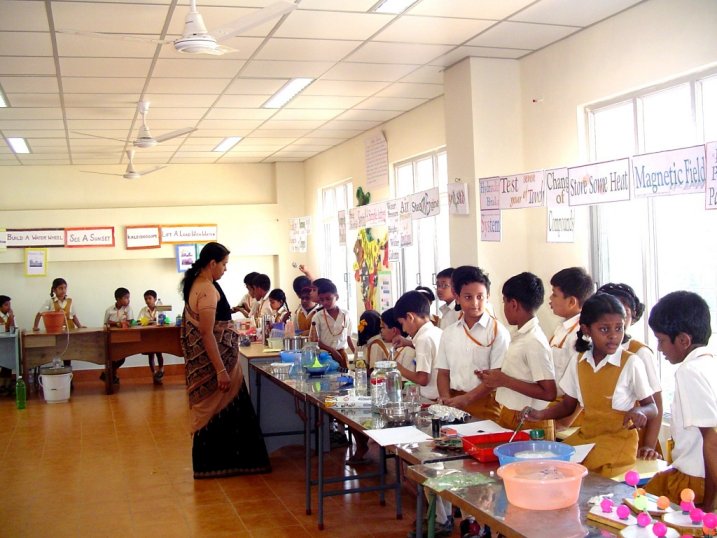
~ Our yearly Science Exhibition from 1st standard upwards is a wonderful occasion for the students to develop their interest in science with hands-on projects.
~ Singing, dancing, and educational games also form part of the syllabus.
Results
In India, the average age of learning to read simple stories is 8 years. Yet, in Primrose School, despite the brief time exposure, very average children are able to read simple Tamil and English stories by the end of 15 months, in lower Kindergarten, or around 4 or 4 ½ years of age. During the same period, the children have also learned to recognize all the states of India, the geography of the country, the continents, peoples of the world and a wide range of plant and animal species.